
Most families in business don’t really have meetings. They have interruptions.
The equipment decision gets made in a truck on the way to a job site. The pay question gets raised at the kitchen counter while somebody’s loading the dishwasher. The succession conversation gets started at Thanksgiving, at about the worst possible moment, by the one person who’s had enough of waiting.
Decisions do get made in those moments. They just get made badly, nobody writes them down, and half the family finds out later from somebody else.
A real family business meeting fixes more of this than you’d expect. Set time. Written agenda. Rules everyone agreed to before the room got hot. It costs you about two hours a month. What it buys back is the argument you’ve been having on repeat for six years.
Here’s how to run one properly.
Why family business meetings go sideways
Around that table, most people are wearing three hats at once. Family member. Owner.
Employee. And they switch between them mid-sentence without telling anyone.
Say the founder asks his son a straightforward question about the equipment budget. The father is asking as an owner. The son hears his dad saying he isn’t ready. His sister, who owns a third of the company but doesn’t work in it, hears a spending decision she wasn’t consulted on. Three people, one question, three completely different conversations.
This isn’t a new observation. Renato Tagiuri and John Davis mapped it at Harvard Business School back in 1978 with what became the Three-Circle Model — family, ownership, and business as three overlapping circles, with seven distinct positions a person can occupy. It’s still the standard framework in the field, and it’s still the clearest explanation for why family business meetings blow up over things that look small from the outside.
The practical takeaway is simple. When nobody names which hat they’re wearing, every topic turns personal.
Stop running one meeting for everything
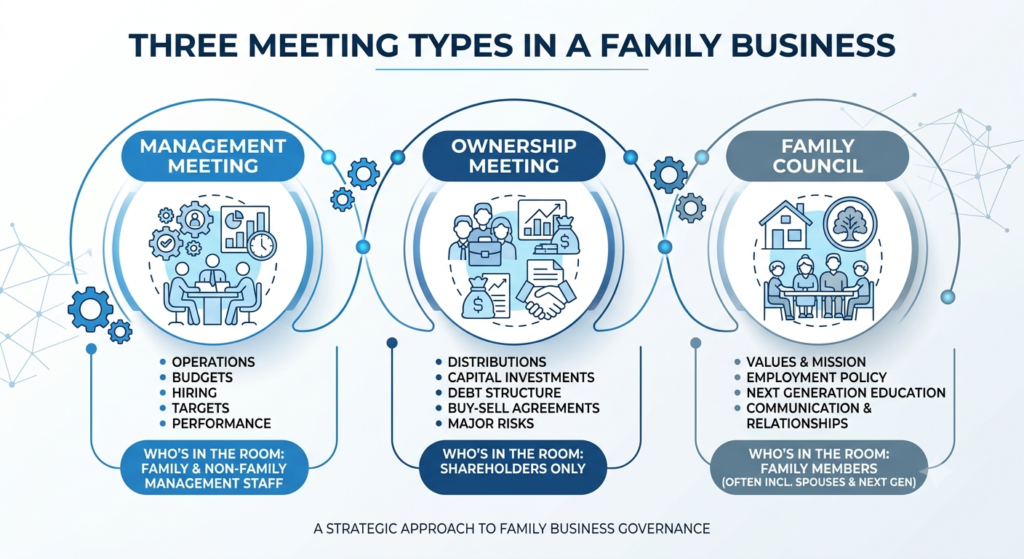
This is the structural fix that changes the most, and almost nobody does it. One meeting is being asked to carry three different jobs. Split it.
| Meeting type | Who’s in the room | What it decides |
| Management meeting | Family and non-family people who work in the business | Operations, budgets, hiring, targets, performance |
| Ownership meeting | Shareholders only, whether they work there or not | Distributions, capital, debt, buy-sell, major risk |
| Family meeting/family council | Family members, often spouses and the next generation | Values, employment policy, education, communication, how the family relates to the business |
Once you separate them, a lot of tension drains out on its own. The sibling who doesn’t work in the business stops feeling talked over, because there’s a meeting where his ownership actually counts. The general manager stops sitting through forty minutes of family history that has nothing to do with the plant.
Most families I work with land on monthly management meetings, quarterly family council meetings, and one proper ownership meeting a year. Adjust to fit. The point is that each one has a different purpose and a different guest list.
What to do before anyone sits down
The meeting is mostly won or lost before it starts.
Put the dates on the calendar for the whole year
Not “we’ll find a time.” Find them now, all of them, and treat them like a loan covenant. A family business meeting that gets rescheduled twice is a meeting that’s quietly been cancelled.
Send the agenda five days ahead, in writing
Anyone can add an item up to 48 hours before. After that, it waits for next time. This single rule kills the ambush, and the ambush is what people are actually afraid of.
Send the numbers early too
Nobody should be reading a P&L for the first time in a room with their brother. Give people three days to have their reaction in private.
Meet somewhere neutral
Not the founder’s office. Not the family kitchen. The room carries history, and the history sits down with you.
Decide who runs it
Rotate the chair, or bring in an outside facilitator. When the founder chairs every meeting, it isn’t a meeting. It’s an announcement with chairs.
A family business meeting agenda that holds up

Ninety minutes. Print it, follow it, and let the clock be the bad guy instead of a person.
0:00 – 0:10 — Check-in. One sentence each, going around. Something like: what’s on your mind coming into today. No responding, no fixing. You’re finding out who walked in carrying something.
0:10 – 0:25 — The numbers. Short. Questions only, since everyone read them already.
0:25 – 0:55 — One topic. One. Not five. Whatever matters most this quarter gets the thirty minutes it deserves. Five topics in thirty minutes is how families convince themselves they discussed something.
0:55 – 1:15 — Decisions. Every decision gets a name and a date attached out loud, in the room. “Marcus, the equipment quotes, by the 15th.” If it doesn’t get a name and a date, it didn’t happen.
1:15 – 1:25 — What we are not deciding today. This one’s underrated. Naming what’s being deferred, and when it comes back, stops people from lying awake wondering if it got buried.
1:25 – 1:30 — Close. One word each on how the meeting went. You’d be surprised what surfaces.
Ground rules that survive contact with a real argument
Write these down. Have everyone sign the page. It feels stiff and formal, and it’s the only reason the rules hold at minute fifty when somebody’s voice goes up.
- One conversation at a time. No side commentary.
- Say the hat. “I’m speaking as an owner right now, not as your father.”
- Nothing older than twelve months comes into the room unless everyone agrees to open it. Otherwise every meeting becomes 2009 again.
- Disagree here, not in the parking lot. The parking lot meeting is what kills family businesses. Not the argument. The second conversation that happens after the first one ended too politely.
- Anyone can call a ten-minute break. No reason required, no questions asked.
- Phones face down, in a basket, out of the room. Yes, really.
The topics everybody avoids
Every family enterprise has a short list of subjects that never make the agenda. Here’s how to get them on there without detonating anything.
Succession. Don’t try to decide it in a meeting. Put a date on the calendar by which it will be decided, and put the criteria in writing first. Deciding when we decide is a decision, and it’s usually the one that unlocks the rest.
Compensation. The argument isn’t really about the number. It’s about whether there’s a policy or just a mood. Write the policy — market rate for the role, bonus tied to something
measurable, ownership distributions handled separately from salary — and the argument shrinks considerably.
Family employment. Write the rules before your niece graduates, not after she’s applied. Outside experience required? Degree? Does everyone get a job, or only open roles? Deciding this in the abstract is easy. Deciding it with a specific twenty-two-year-old’s face in the room is nearly impossible.
A family member’s performance. This one does not belong on the agenda. Ever. Performance is a one-on-one conversation with a manager. Raising it in a family business meeting isn’t accountability; it’s an execution with witnesses, and the family will remember it for twenty years.
In-laws. Decide as a group whether spouses attend, which meeting they attend, and whether they vote. Then say it out loud instead of leaving people to guess. Guessing is what breeds the resentment.
What happens after matters more than what happens during
This is where most families quit, and it’s the cheapest part.
Minutes, one page, sent within 48 hours. Not a transcript. Three columns: decision, who owns it, when it’s due. Anything discussed but not decided goes at the bottom under “still open.”
Then the first item at the next family business meeting is last meeting’s list. Every single time. Read it out, one by one, done or not done.
If nothing on that list ever moves, your problem isn’t the meeting format. Which brings me to the part that no agenda template will solve.
The part structure doesn’t fix
I’ll say the uncomfortable thing.
You can run a flawless family business meeting and still get nowhere. I’ve watched it happen plenty of times. Clean agenda, tight minutes, everyone perfectly civil. And nothing changes, year after year, because the actual issue never made it into the room.
The founder who won’t name a successor isn’t disorganized. He’s not ready to stop being the person everyone needs, and he’s never said that out loud to anyone, possibly including himself. The daughter who’s gone quiet in the last six meetings isn’t disengaged. She decided a long time ago that having an opinion costs more than it’s worth. The two brothers being extremely reasonable with each other are not fine. They’re managing something neither will name.
None of that is an agenda problem. It’s a thinking problem that lives beneath the business.
I spent nineteen years as a partner at Arthur Andersen working with family companies, and I worked directly with Dr. Leon Danco, who more or less founded the field. Then I went and
got a master’s in psychology, because after two decades I’d noticed the same thing over and over: the structural work was never the hard part. Families are capable of building governance. What stops them is what nobody’s willing to say at the table.
So run the meeting. Build the agenda, write the rules, keep the minutes. It genuinely helps, and it’s a good place to start. Just don’t be surprised when the structure gets built, and the stuck thing is still stuck. That’s normal. It means the real work is somewhere else, and it’s usually closer to home than anyone expects.
Start with one meeting
Don’t build a governance system this month. Build one meeting.
Pick a date. Send an agenda with one topic. Ninety minutes, phones away, somewhere that isn’t the office. Write down what got decided and who’s doing it. Do it again in thirty days.
That’s it. That’s the whole beginning. Families who do that for a year end up somewhere completely different from families who wait until the situation forces the conversation, because by then it’s usually a lawyer scheduling it instead of you.
Family business meeting FAQs
How often should we hold a family business meeting?
A common rhythm is monthly for management, quarterly for the family council, and once a year for ownership. Smaller families sometimes fold management and ownership together. What matters more than frequency is that the dates are set a year out and don’t move.
Who should attend?
Depends which meeting. Management meetings are for the people running the business, family or not. Ownership meetings are for shareholders. Family council is for the family, and that’s where you decide how far “family” extends — spouses, adult children, the next generation coming up.
Should spouses and in–laws be included?
There’s no universal right answer, and families split roughly down the middle on it. What causes damage isn’t the decision either way. It’s leaving it unspoken so people have to infer where they stand.
Do we need an outside facilitator?
Not always. You probably do if the founder can’t stop chairing, if the same argument has repeated more than three times, or if somebody has stopped speaking entirely. An outsider isn’t there for expertise so much as for permission — people say things in front of a neutral third party that they won’t say to each other.
What if a family member refuses to come?
Hold the meeting anyway and send them the minutes. Every time. Don’t chase, don’t negotiate, don’t cancel. Most holdouts show up within three or four meetings, once it’s clear the decisions are being made with or without them.
How do we stop a family business meeting from turning into a fight?
Agenda in advance, one topic at a time, the twelve-month rule on old history, and anyone can call a break. Most blowups are old material arriving unannounced. Take away the ambush and take away the surprise, and the temperature drops on its own.
Don Scott is a business coach, with more than forty years inside family enterprises. If your family business meetings have turned into a ritual where nothing changes, start a conversation. Forty-five minutes, no pitch. Just an honest look at what’s actually in the way. Learn more about coaching for family enterprises or what clients say about the work.